
Payroll processing in the United Kingdom operates within a tightly regulated framework that combines tax law, employment law, pension legislation, and digital reporting requirements. Employers are expected to calculate pay accurately, deduct income tax and National Insurance contributions correctly, submit real-time information to HM Revenue & Customs (HMRC), and meet automatic enrolment duties under UK pensions law. Payroll software therefore plays a central operational and compliance role rather than serving as a simple administrative tool.
Among the payroll solutions commonly considered by UK businesses, Sage Payroll and Xero Payroll are frequently compared. Both systems are recognised by HMRC, widely used by employers and accountants, and designed to support statutory payroll obligations. However, they differ substantially in design philosophy, feature depth, scalability, and the types of organisations they best serve.
A meaningful comparison of Sage Payroll vs Xero Payroll requires looking beyond surface-level features. It involves understanding how each system operates in practice, how it aligns with UK regulations, what level of control it provides, and which types of businesses are most likely to benefit from its approach.
What is Sage Payroll?
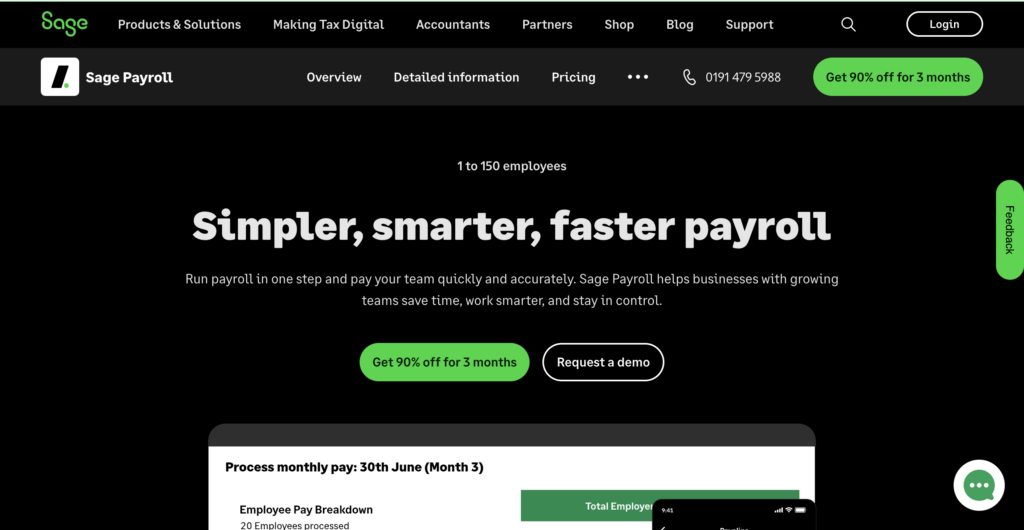
Sage Payroll is a dedicated payroll software solution developed by Sage, a long-established UK-based software provider with a strong presence in accounting, payroll, and enterprise systems. Sage Payroll is designed primarily as a standalone payroll engine, although it can integrate with Sage accounting products and other third-party systems.
In the UK, Sage Payroll reviews show that this is widely used by payroll bureaus, accountants, bookkeepers, and medium-sized employers who require detailed control over payroll calculations and reporting. It is often positioned as a compliance-focused system that prioritises accuracy, configurability, and regulatory coverage.
Core purpose
The primary purpose of Sage Payroll is to calculate employee pay in accordance with UK tax and employment law, generate compliant payslips, submit required data to HMRC, and maintain detailed payroll records. It supports both simple and complex payroll scenarios, including multiple pay frequencies, statutory payments, and varied employee arrangements.
What is Xero Payroll?
Xero Payroll is a payroll module within the broader Xero cloud accounting ecosystem. Unlike Sage Payroll, which exists as a standalone payroll product, Xero Payroll is tightly integrated with Xero’s accounting platform and is designed to operate as part of an all-in-one financial management system.
In the UK, Xero Payroll is most commonly used by small businesses already operating on Xero Accounting, particularly those with relatively straightforward payroll needs. Its design prioritises usability, automation, and seamless data flow between payroll and accounting.
Core purpose
Xero Payroll aims to simplify payroll processing by automating calculations, syncing payroll data directly with accounting records, and reducing manual data entry. It is intended to allow business owners and small finance teams to manage payroll without requiring specialist payroll expertise.
How Sage Payroll works in practice
Sage Payroll operates as a rules-based payroll engine. Users configure employee records with detailed information including tax codes, National Insurance categories, pay rates, pension schemes, and statutory entitlements. Once configured, the system calculates gross pay, deductions, and net pay according to current UK legislation.
The software supports:
- PAYE income tax calculations;
- Employee and employer National Insurance contributions;
- Student loan and postgraduate loan deductions;
- Statutory Sick Pay (SSP);
- Statutory Maternity, Paternity, Adoption, and Shared Parental Pay;
- Attachment of earnings orders.
Sage regularly updates the software to reflect changes announced by HMRC, such as tax thresholds, National Insurance rates, and reporting rules.
HMRC reporting and compliance
Sage Payroll is fully compatible with Real Time Information (RTI) submissions. It supports:
- Full Payment Submissions (FPS)
- Employer Payment Summaries (EPS)
- Earlier Year Updates (EYU), where applicable
The system includes validation checks designed to reduce submission errors before data is sent to HMRC. It also maintains detailed audit trails, which can be important during HMRC inspections or internal reviews.
Pension auto enrolment
Sage Payroll supports UK workplace pension obligations, including:
- Assessment of employee eligibility;
- Calculation of employer and employee contributions;
- Postponement and opt-out handling;
- Data exports for pension providers.
The software can integrate with major pension schemes, although configuration often requires careful setup and ongoing management.
How Xero Payroll works in practice
Xero Payroll calculates pay using employee profiles that are closely linked to the accounting chart of accounts. Pay items, deductions, and contributions are mapped directly to ledger accounts, allowing payroll costs to flow automatically into financial reports.
The system supports:
- PAYE and National Insurance calculations;
- Automatic tax code updates via HMRC;
- Statutory payments;
- Student loan deductions.
While Xero Payroll covers standard UK payroll requirements, it offers fewer configuration options than Sage Payroll, particularly for non-standard pay arrangements.
HMRC reporting and compliance
Xero Payroll supports RTI submissions directly from the platform. FPS and EPS filings can be submitted without leaving the Xero environment, and submission status is clearly displayed within the interface.
Compliance features are designed to be largely automated, with the system prompting users when submissions are due or actions are required.
Pension auto enrolment
Xero Payroll includes built-in pension functionality that integrates with selected UK pension providers. It automates eligibility assessment, contribution calculations, and ongoing compliance tasks. This approach suits employers who want minimal manual involvement in pension administration.
Key regulatory context affecting both systems
Under UK law, employers must operate PAYE and submit payroll data to HMRC every time employees are paid. Both Sage Payroll and Xero Payroll are designed to meet RTI requirements, but they differ in how much manual oversight they assume from the user.
Employment law considerations
Payroll systems must support compliance with employment law, including National Minimum Wage rules, holiday pay calculations, and statutory leave entitlements. While both systems provide basic support, responsibility for correct setup and interpretation of the law ultimately remains with the employer.
Data protection and GDPR
Payroll data includes sensitive personal information. Both Sage and Xero operate under UK GDPR requirements, offering security controls, access permissions, and data retention options. Employers are still required to ensure appropriate internal controls and lawful processing.
Comparison of Sage Payroll and Xero Payroll
| Feature area | Sage Payroll | Xero Payroll |
|---|---|---|
| Deployment | Desktop and cloud options | Fully cloud-based |
| Primary focus | Dedicated payroll compliance | Integrated payroll and accounting |
| Suitable business size | Small to medium, payroll bureaus | Micro to small businesses |
| Configuration depth | High | Moderate |
| Accounting integration | Via Sage products or exports | Native, real-time integration |
| Pension handling | Detailed, configurable | Automated, provider-led |
| Reporting | Extensive payroll reports | Simplified reporting |
| Learning curve | Steeper | Lower |
Sage Payroll is typically a strong fit for:
- Employers with complex payroll structures;
- Businesses with multiple pay frequencies or payroll groups;
- Organisations with in-house payroll professionals;
- Accountants and payroll bureaus managing multiple clients.
The system’s strength lies in its flexibility and control, but this also requires a higher level of payroll knowledge.
Xero Payroll tends to suit:
- Small businesses already using Xero Accounting;
- Employers with straightforward payroll needs;
- Business owners handling payroll themselves;
- Organisations prioritising automation over configurability.
Its design reduces administrative effort but may be limiting in more complex scenarios.
Common risks and warning signs
Over-automation risks
Relying too heavily on automation without understanding payroll rules can lead to unnoticed errors. Both systems require users to review outputs and ensure employee data is accurate.
Misalignment with business growth
A payroll system that works for a start-up may become restrictive as the business grows. Changing systems later can be disruptive, particularly where historical data and reporting are involved.
Pension compliance gaps
Automatic enrolment duties remain a common source of compliance risk. Employers should ensure that pension settings are reviewed regularly, regardless of the software used.
Practical recommendations
- Assess payroll complexity before choosing software;
- Consider who will operate the system and their level of expertise;
- Review integration needs with accounting and HR systems;
- Plan for future growth rather than current size alone;
- Maintain independent payroll knowledge alongside software use.
The comparison between Sage Payroll and Xero Payroll highlights that there is no universally superior option. Sage Payroll offers depth, control, and suitability for complex or professional payroll environments, while Xero Payroll provides simplicity, automation, and seamless accounting integration for smaller UK businesses. The most appropriate choice depends on regulatory exposure, internal capability, and long-term operational needs rather than feature lists alone.
{ “@context”: “https://schema.org”, “@graph”: [ { “@type”: “WebPage”, “@id”: “https://www.best-payroll-software.co.uk/sage-payroll-vs-xero-payroll/#webpage”, “url”: “https://www.best-payroll-software.co.uk/sage-payroll-vs-xero-payroll/”, “name”: “Sage Payroll vs Xero Payroll”, “description”: “Detailed UK-focused comparison of Sage Payroll and Xero Payroll covering features, compliance, HMRC reporting, pensions and practical business insights.”, “inLanguage”: “en-GB”, “datePublished”: “2026-01-24”, “author”: { “@type”: “Organization”, “name”: “Best Payroll Software”, “url”: “https://www.best-payroll-software.co.uk/” }, “publisher”: { “@type”: “Organization”, “name”: “Best Payroll Software”, “url”: “https://www.best-payroll-software.co.uk/” } }, { “@type”: “SoftwareApplication”, “@id”: “https://www.best-payroll-software.co.uk/sage-payroll-vs-xero-payroll/#sage-payroll”, “name”: “Sage Payroll”, “applicationCategory”: “BusinessApplication”, “operatingSystem”: “Windows, macOS, Web-based”, “description”: “Payroll software used by UK employers to manage PAYE, National Insurance, statutory payments, RTI submissions and workplace pension obligations.”, “publisher”: { “@type”: “Organization”, “name”: “Sage” }, “featureList”: [ “PAYE and National Insurance calculations”, “RTI submissions to HMRC”, “Statutory payments management”, “Workplace pension support”, “Comprehensive payroll reporting” ] }, { “@type”: “SoftwareApplication”, “@id”: “https://www.best-payroll-software.co.uk/sage-payroll-vs-xero-payroll/#xero-payroll”, “name”: “Xero Payroll”, “applicationCategory”: “BusinessApplication”, “operatingSystem”: “Web-based”, “description”: “Cloud-based payroll solution integrated with Xero Accounting, designed for UK businesses with straightforward payroll requirements.”, “publisher”: { “@type”: “Organization”, “name”: “Xero” }, “featureList”: [ “Integrated payroll and accounting”, “RTI submissions”, “Automatic tax code updates”, “Workplace pension automation”, “Simplified payroll processing” ] }, { “@type”: “Review”, “@id”: “https://www.best-payroll-software.co.uk/sage-payroll-vs-xero-payroll/#review”, “itemReviewed”: { “@type”: “Thing”, “name”: “Sage Payroll vs Xero Payroll” }, “author”: { “@type”: “Organization”, “name”: “Best Payroll Software”, “url”: “https://www.best-payroll-software.co.uk/” }, “publisher”: { “@type”: “Organization”, “name”: “Best Payroll Software”, “url”: “https://www.best-payroll-software.co.uk/” }, “reviewBody”: “This comparison examines Sage Payroll and Xero Payroll in the context of UK payroll compliance, operational complexity, and suitability for different business sizes.”, “reviewAspect”: [ “Compliance”, “Ease of use”, “Integration”, “Functionality”, “Business suitability” ] }, { “@type”: “FAQPage”, “@id”: “https://www.best-payroll-software.co.uk/sage-payroll-vs-xero-payroll/#faq”, “mainEntity”: [ { “@type”: “Question”, “name”: “Is Sage Payroll suitable for small UK businesses?”, “acceptedAnswer”: { “@type”: “Answer”, “text”: “Sage Payroll can be used by small businesses, but it is generally more suitable where payroll requirements are complex or managed by professionals.” } }, { “@type”: “Question”, “name”: “Does Xero Payroll comply with HMRC RTI requirements?”, “acceptedAnswer”: { “@type”: “Answer”, “text”: “Yes, Xero Payroll supports RTI submissions including Full Payment Submissions and Employer Payment Summaries.” } }, { “@type”: “Question”, “name”: “Can both systems handle workplace pensions?”, “acceptedAnswer”: { “@type”: “Answer”, “text”: “Both Sage Payroll and Xero Payroll support UK workplace pension obligations, though their level of configurability differs.” } } ] }, { “@type”: “DefinedTermSet”, “@id”: “https://www.best-payroll-software.co.uk/sage-payroll-vs-xero-payroll/#definitions”, “name”: “UK Payroll Terms”, “hasDefinedTerm”: [ { “@type”: “DefinedTerm”, “name”: “PAYE”, “description”: “Pay As You Earn system used by HMRC to collect Income Tax and National Insurance from employment income.” }, { “@type”: “DefinedTerm”, “name”: “RTI”, “description”: “Real Time Information reporting framework requiring employers to submit payroll data to HMRC each pay period.” }, { “@type”: “DefinedTerm”, “name”: “Automatic Enrolment”, “description”: “UK legal requirement for employers to enrol eligible workers into a workplace pension scheme.” } ] }, { “@type”: “Comparison”, “@id”: “https://www.best-payroll-software.co.uk/sage-payroll-vs-xero-payroll/#comparison”, “name”: “Sage Payroll vs Xero Payroll Comparison”, “mainEntity”: [ { “@type”: “SoftwareApplication”, “name”: “Sage Payroll” }, { “@type”: “SoftwareApplication”, “name”: “Xero Payroll” } ], “description”: “Structured comparison of Sage Payroll and Xero Payroll based on compliance, functionality, complexity and suitability for UK employers.” } ] }